Columbia University
January 27, 2017 · with Bill Gates
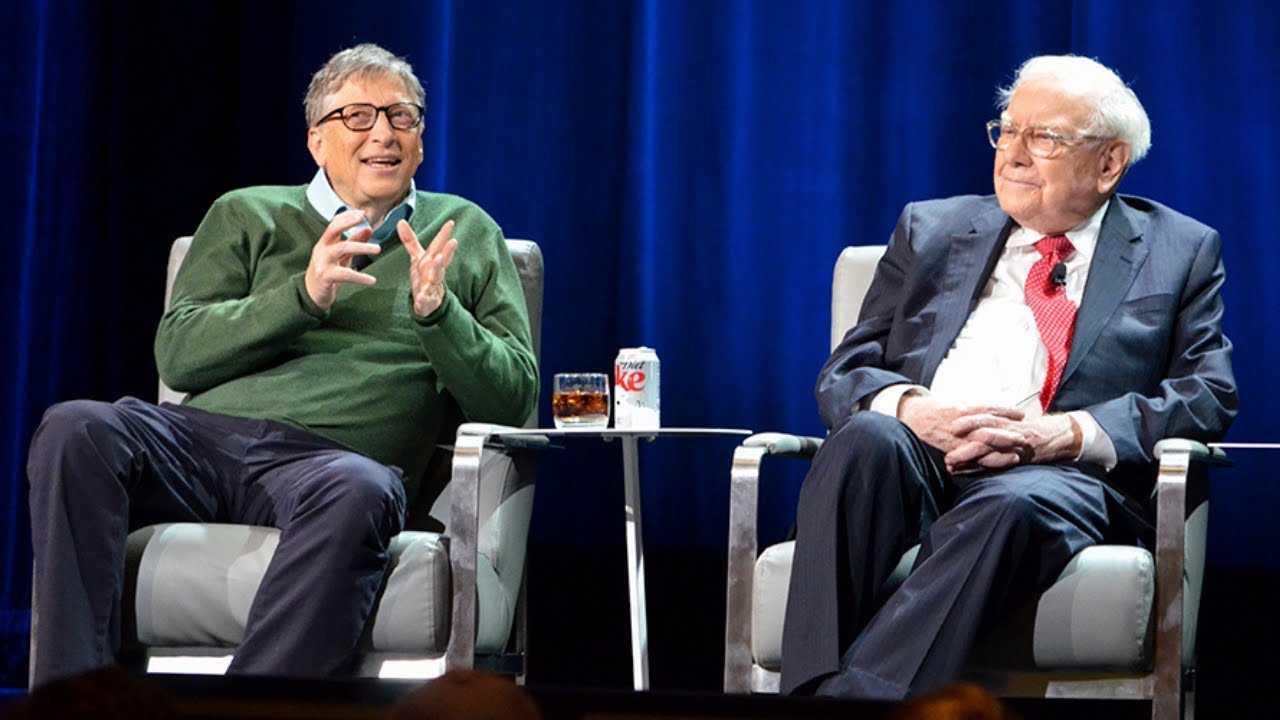
Summary
Friendship and curiosity
The host opens by asking what the two men share that makes their friendship so satisfying. Buffett answers that they share a curiosity about the world and come from two different but related worlds. Their first meeting was scheduled for one hour on July 5th, 1991, and Gates's mother had to talk him into it. They talked for about ten hours, and Gates's father had to pull them out of the room. Buffett says every relationship should have a lot of fun in it, and that they find the world so interesting that they like to compare notes on it.
That first night Gates's father asked each of them to name the most important quality behind their success, and both wrote the same word: curiosity. Gates explains how it works. You try to predict what will happen, and when it does not happen, whether a drug was not invented or a stock did not go up, you ask what is wrong with your model of the world, who you could talk to and what you could read. Buffett adds that focus is another trait they share.
Reading and what they admire in each other
Gates calls this an incredible time to be a learner, with online videos and courses from the very best professors on subjects like climate change and economics. For the foundation, a lot of what he needs to learn is biology, such as how vaccines are made. Buffett says he practically lived in the Columbia library. He pulled out Who's Who in America, which told him something about his professor Benjamin Graham, and a librarian pointed him to another book. He followed that thread, he says, which is why they own GEICO today. He still reads five or six hours a day and loves biography.
Buffett jokes that what surprised him about Gates is that Gates once tried to sell him a computer, probably the only sale of Gates's that Buffett did not go through with. Gates says he was amazed by how broad Buffett's model of the world is. One of Buffett's first questions was why small Microsoft could beat huge IBM at software, and nobody had ever asked him that. Buffett also explained clearly why some banks get ahead and others do not.
Vaccines and misinformation
A student asks how future health leaders should resist political rhetoric against vaccination. Gates says the facts are clear and strong: vaccines are safe, and the schedule was designed to reduce disease. The more parents follow it, the more their own children and also immune-deficient children are protected. Diseases such as measles or pertussis need only a small cluster, and in some European countries there have been deaths because children were not vaccinated.
The bigger risk, Gates says, concerns polio eradication, which only succeeds if ninety-five percent of children are vaccinated. Boko Haram in Nigeria and the Taliban in Pakistan and Afghanistan claimed that vaccination was a US plot to sterilize women, and they killed a number of the women who give oral polio drops at children's homes. Eradication began in 1988, and there were fewer than fifty cases worldwide in 2016 and 2017. The cases are so few that the virus is tracked through sewage samples, which show about four places in Pakistan and Afghanistan and one in Nigeria not yet reached.
Hope and worry in a new political era
Asked what they hope for and worry about, Buffett says he is confident America will move ahead. Real GDP per capita has risen six for one since he was born, and he calls the baby born today in this country the luckiest in the history of the world. He bought his first stock at eleven, in April 1942, with the Dow around 100, and it is now over 20,000. As a teenager in Omaha he saw more than fifty polio cases in one ward, a number that is now the yearly total worldwide.
Gates shares the optimism, citing strong American innovation and largely bipartisan support for research. His worry is foreign aid, about thirty billion dollars a year, which makes the US the biggest donor, and which new leadership must be shown is well spent. PEPFAR alone costs over five billion dollars a year, has saved over ten million lives, and is larger than his foundation, the largest in the world. Private philanthropy cannot replace it, he says. Governments provide about 130 billion dollars a year to lift poor countries in health and education, and losing that consensus would cost millions of lives.
Capital and risk-taking
Gates says the ability of bright, energetic people to get financing is dramatically better than it was fifty or sixty years ago, because there is much more capital, people are more optimistic about business, and there are better ways to connect capital to ideas. Buffett agrees and stresses the willingness to take risk. The first venture capital funds date from the 1960s and were tiny. When Microsoft took outside investment, it was at a valuation of twenty million dollars. Gates says Microsoft did not need the money but wanted people on its board for advice, and by 1984 there were dozens of venture capitalists.
The book that changed Buffett's life
Asked for a book that changed his life, Buffett names The Intelligent Investor by Benjamin Graham, who taught at Columbia, which he read at nineteen. He had been interested in investing since he was seven or eight, and by eleven had read almost every book on the subject in the public library. But he had no framework: he knew what everybody thought, whereas Graham made sense. He happened to pick the book up at a bookstore in Lincoln, Nebraska. Investing, he jokes, was what remained once he had zeroed out his other incompetencies.
The right temperament matters much more than IQ, he says. With more than 120 points of IQ you should sell the rest, because you do not need it, but you must be able to think for yourself. The first question he asks of a business is whether it is important and easy for him to determine, and many do not make the cut. Gates takes on the hard questions that plague society, while Buffett looks for one-foot bars to step over rather than eight-foot bars to jump over. He also recommends Katharine Graham's honest autobiography.
Facing fear and setbacks
Asked how they overcame the fear of failure, Gates says he was lucky. The computer came to his high school, he became fanatical about it, and he saw it as a fun hobby rather than a risk. If Microsoft had failed, he had no children and could have finished his degree and found a job. Running the company he was actually risk-averse, always keeping enough money in the bank to pay everybody for at least a year, since he was twenty and hiring people with families. He urges young people to try fields that are not popular. The real risk, the host suggests, would have been not acting, and Gates agrees.
Buffett says he is as excited about tomorrow as when he started. At Columbia he was so afraid of public speaking that he signed up for a Dale Carnegie course and then stopped payment on the check. Eventually he paid a hundred dollars in cash instead, and having parted with it he felt he had to make the most of the course. It changed his life. He adds that being turned down by Harvard was one of the best things that ever happened to him: do not let a setback eat at you, do not look back, and keep going.
Career advice
Asked what business he would start today, Buffett says he would do the same thing, since he would probably fail at anything else. His advice to students is to look for the job they would take even if they did not need one. Do not sleepwalk through life or treat it as marking time until you are older. You may not find what you love on your first job, but do not give up before you find it.
Asked the same question, Gates says he would still pick computer science, because work in artificial intelligence is at a profound level, and he cites the AlphaGo milestone from the DeepMind people at Google. He also names energy, since the world needs power that is reliable, cheap and clean and no system today provides it. His third choice is biology, where he expects progress on obesity, cancer and even depression, and where vaccine and drug work for infectious diseases is moving faster than ever.
Automation and the future of work
A student asks about unemployment caused by automation. Buffett says that in 1800 someone could have predicted that tractors and better fertilizer would shrink farm employment from eighty percent of people to two or three percent, and asked what would become of them. The answer is that they are released for other work. Keynes wrote around 1930 that within a hundred years output per person would be four to eight times higher. To see more output per capita as harmful is crazy, Buffett says, but people who fall by the wayside through no fault of their own should still share in the prosperity, and that is where government comes in.
Gates distinguishes a problem of excess from a problem of shortage. If all the tractors and computers stopped working we would have a shortage, but excess forces us to look at the individuals affected and direct resources to them, through re-education and income policies. Demand for labor is not zero: there is room for smaller class sizes, for helping handicapped children and for reaching out to the elderly.
Public education, climate and the long term
Gates calls education hugely important. Dropout rates remain high and closely tied to income, and many graduates need remedial courses and then leave higher education, often with debt. He sees points of light: some New York City charter schools do a phenomenal job with fewer resources, and countries such as China, South Korea and Singapore spend less of their GDP on education and still do well. Lessons include building the right culture and giving teachers feedback. Spreading those practices is hard because institutions resist change, but it is a top priority for the foundation in the United States.
On climate, Gates says the topic is so complicated that broad public understanding is hard, especially when people exploit the complexity to manufacture uncertainty. India wants to electrify for good reasons, and the ideal is to innovate so it can do so without the CO2 that coal would produce. Costs must fall, because rich countries can afford premium clean electricity and poorer ones cannot yet.
Buffett adds that investing for the long term is easier than doing so in society. If he knew how to double his money tomorrow he would probably invest short term too, but he has a high-probability view of the next ten or twenty years even though he has no idea what happens next week. Politicians face elections every two or six years, and the way districts are drawn makes primaries matter more. Few people vote in them and they tend to be at the extremes, so it is hard to champion something good over twenty years if it might cost the next election.
What makes a good investment
Asked about the test he applies to a company, Buffett says he looks for a durable competitive advantage, something with a moat around it for a considerable period, and honest and able management, because he does not know how to run the business himself. The price must not be excessive. It is better to pay a little too much for a very good business than to buy a bargain in a company without much of a future. He cannot predict most companies with high probability, so he looks for the exception. Like Ted Williams's strike zone, but with no called strikes, he can let company after company go by until one lands in his sweet spot.
Munger refined his view in a huge way, Buffett says, toward quality companies and investments that work out over five, ten or twenty years. Before that he practiced what he calls cigar-butt investing: picking up disgusting-looking cigars with one puff left, taking the puff and moving on. That worked, but it does not scale and builds nothing satisfying. Munger kept pushing him to ask whether this is a business we want to own forever, much like a marriage, where you ask whether you want to be associated with this person forever.
Partners
Gates says Melinda has been his partner in philanthropy from day one. At Microsoft he had two partners, Paul Allen in the early days and Steve Ballmer as the company grew, and when things get tough, having someone truly committed beside you matters enormously. Melinda thinks about human issues better than he does and keeps the foundation realistic when he gets overexcited about the science. Buffett says it is more fun with a partner, and that he and Munger have never had an argument in fifty-eight years of working together.
Choosing where to give
Buffett says he went wholesale. He had planned to accumulate the money and let his first wife distribute it after he was gone, but she died in 2004. He wanted people with similar values who would pour in intelligence and energy, and Bill and Melinda work at it full time and see the world as he does: every life has equal value. Retail philanthropy would drive him crazy, he says, but wholesale philanthropy he really likes.
Gates says the foundation's belief comes from innovation, the same force that drove Microsoft. A new vaccine can be expensive to develop, but its marginal cost drops below a dollar, so he looks for dramatic opportunities, since philanthropic dollars are tiny compared with government funding. His biggest lesson was that a new vaccine is not enough, because the delivery system does not reach many children. That drew the foundation into primary healthcare. Vaccines now reach eighty-six percent of the world's children, up from about seventy when the foundation started, with fourteen percent still to go.
Giving at home or abroad
A student asks why wealth should go abroad when there are pressing problems in America. Buffett says every life has equal value, and that with a limited number of dollars you can often do more for more people outside the United States. There are far greater resources here for 320 million people than exist for seven-plus billion worldwide. He calls himself an accident who won the ovarian lottery by being born in the United States in 1930, and male.
Innovation, money in politics and the Giving Pledge
On encouraging innovation among the young, Buffett says you need a market system that rewards it, and America is an incubator for innovation: Gates can drop out of school and Andy Grove can come from Hungary, and the country welcomes them. How prosperity is divided is a secondary question the market solves less well. On money in politics, Buffett thinks it is bad news for the country, and he calls Citizens United a terrible decision, since someone can pour millions into a campaign, sometimes without even being identified. Gates says both chose not to make big political donations a major part of their giving.
Buffett says the Giving Pledge is going terrifically. It brings together people with over a billion dollars who are committed to giving away most of their wealth and who can learn from each other what has worked, how to involve their kids and how to hire staff. They hoped for twenty or twenty-five people and are now at 156. He believes the quantity and quality of giving have gone up, even if that can never be measured directly.
Relationships
A student asks how to decide which relationships to foster. Buffett says you will move in the direction of the people you associate with, so associate with people better than yourself, the kind of person you would like to be. The most important decision most students will make is the spouse they choose, and he cannot overstate that. Friends will form you, so make good ones and keep them for life, friends you admire as well as like.
Immigration and healthcare
Asked what advice he would give a government on immigration, Buffett says the country is built on it, and that people against immigration should apply that idea retroactively, after which everybody leaves. He points to the August 1939 letter in which two immigrants, Leo Szilard and Albert Einstein, warned President Roosevelt that the Germans were likely to develop an atomic bomb. The Manhattan Project came out of it. This country has been built and blessed by immigrants, he says, who find something that unleashes the potential the places they left did not.
On healthcare, Buffett says the share of GDP devoted to it, already around eighteen percent, will keep rising, as an aging society and advances such as joint replacement and organ transplants will need more resources, including more from government. Gates sees both access problems and cost problems, and his lens is that innovation should help. A cure for Alzheimer's would save huge long-term care costs, but progress on some chronic diseases is lacking and new treatments will be very expensive. He cites an article by Atul Gawande noting that surgeons doing heroic operations are paid twice as much as those doing ongoing, incremental work with patients.