University of Nebraska
2005 · with Bill Gates
Summary
Introduction
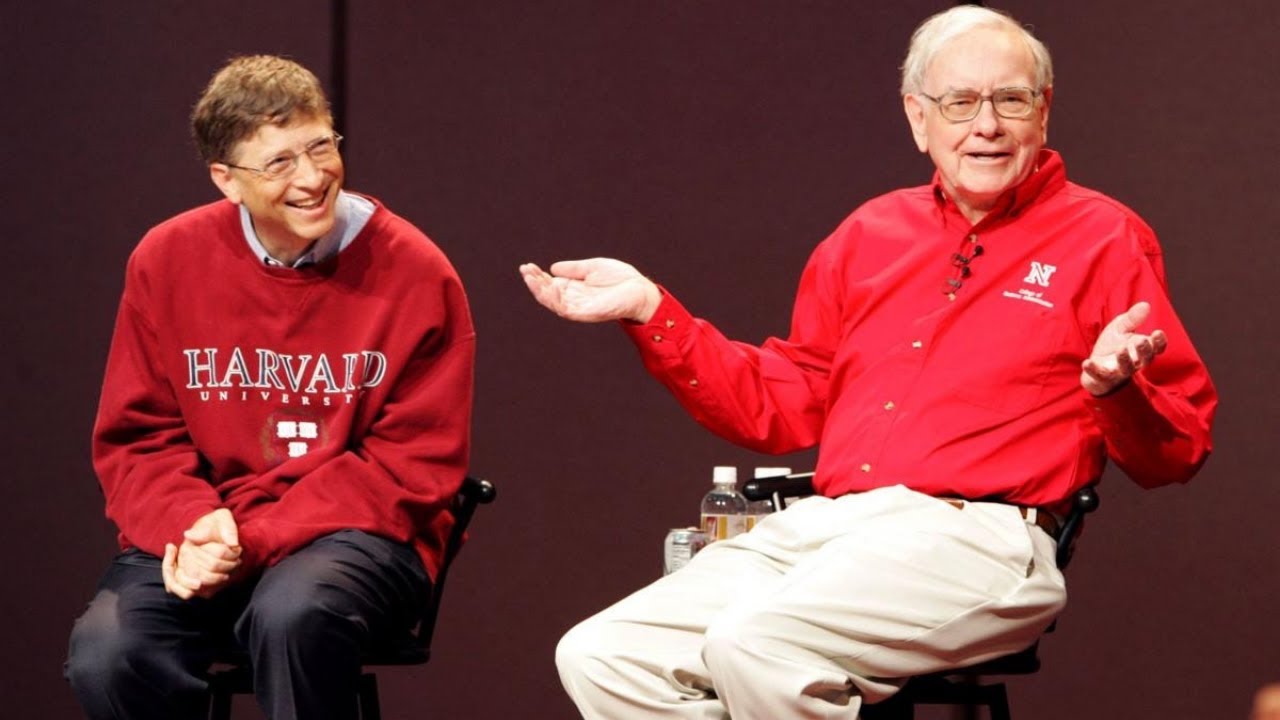
This program brings Warren Buffett and Bill Gates to the University of Nebraska College of Business Administration, where Buffett earned his bachelor's degree in 1950. The narrator describes two very different fortunes. Buffett made about $41 billion the old-fashioned way, investing in solid, old-line companies that sell basic products such as insurance, soft drinks, home improvement and shoes. Gates made about $50 billion as the modern genius behind Microsoft. They are close friends, and they set one condition for the event: only students would ask questions, and none had been shared with either man in advance.
Ethics and management philosophy
Asked how a leader instills ethical behavior, Buffett says Berkshire can afford to lose money but cannot afford to lose even a shred of reputation. He asks managers to judge every action first by the law and then by what he calls the newspaper test: how would you feel if a smart but somewhat unfriendly reporter wrote it up in your local paper, to be read by your family, friends and neighbors? If it passes, it is fine. If anything is close to the line, it is out.
Gates adds that most of Microsoft's top managers joined right after school, and that the company reviews each year the particular risks of a firm with high market share and business all over the world, such as dealings with suppliers and gifts. Mostly, he says, watching these people in action is what gives him confidence in their behavior. Gates says that in many ways Microsoft's business is fairly simple: it is about writing great software.
Succession, and how they met
Asked whether he might succeed Buffett now that he sits on the Berkshire board, Gates says joining last December was an honor, though the director's fee would not even cover his flight to Nebraska. He expects to help make sure Berkshire grooms the right people, but the successor will not be him. Buffett says it is a real act of friendship for Gates to give his time.
Buffett recalls that they met on July 5th, 1991, at a gathering on the Hood Canal arranged through a friend at the Washington Post who knew Gates's parents. Gates says he did not believe in vacations then and told his mother he was busy, but she insisted. He arrived by helicopter planning to leave within hours and was still there talking with Buffett at day's end. For fourteen years they have found every excuse to get together. Buffett's moral: listen to your mother.
A day in the life
Gates says his calendar is full of meetings, he writes long emails at night after the children are in bed, and about a quarter of his time goes to traveling and meeting customers in Europe and Asia. He also takes two weeks a year to read and think without interruption, which he calls Think Week. He loves a job where new technology and even video games are serious subjects, and he wants games to become more social, with friends online, spectators and contests.
Buffett says he is on Think Week about fifty weeks a year and works about two. His days are unstructured, with no meetings, because he does not like them. He reads a great deal and spends a moderate amount of time on the phone. His businesses basically run themselves, and his job is allocating capital. Both men, he says, are extraordinarily lucky to do what they like, the way they like, with people they choose.
Best advice and the inner scorecard
Gates says a piece of advice he treasures came from Buffett. When they planned to meet again, Buffett pulled out a calendar with nearly blank pages, and Gates remarked that he had managed to avoid getting tied into a lot of meaningless activity. Buffett replied that you have to be good at saying no and pick the things that really make a difference.
Buffett says he got plenty of good advice from his father, who never lectured but taught by example. The lesson he took was that your inner scorecard matters more than your outer scorecard. Some people think all the time about what the world will think instead of what they think. If your inner scorecard is one you are comfortable with, he says, you will probably have a happy life, while those who strive too hard for the outer one sometimes find it hollow in the end.
Who do you turn to for advice?
Asked whom they consult, Buffett says he usually looks in the mirror. His work demands independent thinking, because taking a poll would only lead him to do what everyone else does, which he does not think much of in investing. He has a terrific partner in Charlie Munger, who thinks much as he does, so they talk only occasionally. He believes groups grow more homogenized as they get larger, and that a large committee never produces brilliant investment decisions.
Gates says his biggest decisions, such as which technologies Microsoft will bet on, resemble investments in that you must be willing to be contrary. For tough decisions he turns to his father, Buffett and his wife Melinda. Buffett adds that his forty managers likewise run their businesses without checking in. Berkshire bets on brains, energy and integrity, and would lose a great deal with layers of committees.
Careers, talent and rising in an organization
A student asks how a new graduate can move up. Buffett says he did not realize when he left school how much an unusual person stands out. It is not a matter of a 200 IQ but of behavior: energy, commitment, the quality of the work and how one treats others. He urges getting comfortable with public speaking, an asset that lasts fifty or sixty years, or a liability if you avoid it. Getting the best out of the people around you is rare and does not correlate with IQ.
Gates says people at Microsoft can rise after only a few years, whether because they are good at strategy, which is mostly about writing things well, because they lead people, or because they are strong individual contributors. The company tries to build good career paths for each. The ideal person is good at all three, and higher jobs demand all of them. He finds it striking how rare that combination is.
Habits, heroes and following your passion
Asked what shaped his early success, Gates admits to a bad college habit. He liked to show that he did no work, then got serious two days before the test, and people found it funny. In business nobody praised last-minute effort, and it took him a couple of years to get over it. He tells students procrastination is not a good habit.
Buffett adds that the people you look up to shape the person you become, so have the right heroes. He offers two pieces of advice. First, invest as much in yourself as you can, because you are your own biggest asset and most people use only a small part of their potential. Second, follow your passion and do not take a job just for the money or for people you do not feel good about. He joined Ben Graham, his hero, without asking the salary.
Globalization and small business
A small business owner asks how globalization will affect small firms. Buffett says most will not be affected much. If you bring customers something they want at a price that makes sense for them, you will not be undercut by someone in China. But a major textile, shoe or furniture business is deeply affected by production costs around the world, so globalization is worth tracking because it changes the rules of the game.
Gates agrees that a local, differentiated business is hard for a distant competitor to copy. He calls China the biggest change agent, saying it is in some ways even more capitalistic than the United States in letting businesses develop and keeping things efficient. Whatever career students choose, they should consider the indirect effects on the companies they might work for.
Mistakes and missed opportunities
Asked for his worst investment, Buffett answers, "How long do you have?" He has made some very bad ones but does not dwell on them or look back. You should avoid mistakes on the big decisions, such as whom you marry. The biggest mistakes, he says, are mistakes of omission rather than commission. Berkshire has never lost that much on any single investment, but it has missed profits of as much as, maybe, ten billion dollars on things he knew enough to do and did not do.
Not buying Microsoft early was not such a miss, he explains, because he did not know enough to decide. The real misses were cases where he understood the business and either did nothing or acted on a small scale, sucking his thumb when he should have been writing checks. No ledger records them. Still, he would never get too hung up on mistakes, since tomorrow is another day.
Gates says Microsoft's worst mistake would be missing a major breakthrough in how software is done. Being too early does not bother him, as with delivering television over the internet, where the company moved perhaps five years ahead of need. He admits some catching up in internet search, and says people underestimate Microsoft's ability to move to the front. He also recalls that the company had to push hard into the internet when it arrived, and that IBM ending its relationship with Microsoft to compete with it was a big challenge.
Changing the world
A student asks how to decide when you want to leave the world better than you found it. Buffett answers that you change the world every day. If nothing else, your children form their view of the world from you. One of the best things you can do is surround yourself with high-grade people, because you behave as they do and they in turn take from you. Expect no dramatic shazam moment.
Gates adds that it is important, as early as possible, to see how less successful people live and what holds them back, and later to see places where conditions are far worse than here. At first this can be discouraging, but things are improving, and a small number of capable people can make a very dramatic difference, for example with medicines or education.
The biggest societal challenges
Asked about the most challenging issues for the next generation, Buffett points to equity, between countries and within the United States. If things get too far out of whack, you get a divide and lose the fluidity and sense of opportunity the country has stood for. He says the nation must renew its commitment to the ideals of equality, and that there is a lot it should be doing to invest in the long term that, at this stage, it is not doing.
The next answer builds on this with the idea of lucky tickets in life: a ticket that said American, one that said intelligent, and one that said this time rather than two hundred years ago, when the same talents would have produced little. The speaker argues for taking better care of those who draw bad tickets at home, and for helping people worldwide, for instance with vaccines for children who die young, in families destroyed by things we could actually do something about.
One superpower
Asked which superpower they would want, one answer is extending one's lifetime, which sounds reasonable to the speaker. Buffett says getting rid of competitors would not be much fun, like hitting a hole-in-one every time. He would rather read super fast, since Gates reads about three times as fast as he does and he probably wasted ten years reading slowly.
A more serious answer follows: the wish would be to reduce the threat from nuclear knowledge. That, the speaker says, will be the great problem of mankind in the students' lifetimes. The genie is out of the bottle, there are evil people in the world, and the question is how to keep their intent from being coupled with widespread knowledge that could do enormous damage. It is so tough a problem that it remains something of a dream.
Raising children with wealth
Asked how they keep their children valuing things that are not material, Buffett says he was lucky. His children did not think he was rich, and for a while he was not. Even afterward the family stayed in the same house, the only primary home they have known, and the children attended public schools in Omaha in a neighborhood of roughly average income.
Gates recommends giving children an allowance early and sticking to it, so they learn that a candy bar today means none later. His children will travel to Africa and Asia and see that the United States is statistically an aberration. He hopes people treat them for who they are, and says it would bother him a lot if someone approached them only to influence something through them. Every kid should be judged on what he is actually doing.
Buffett adds that his children will be rich by the world's standards but do not expect to inherit a significant part of his fortune. About 99 percent of what he has will go to philanthropy, and Gates has the same attitude. He dislikes dynastic fortunes: if America means a fair shot at the brass ring for everyone with talent, handing large positions to someone because of the womb he came from seems almost un-American.
Taxes and fairness
A student asks about a flat income tax. Buffett would not support it, because the system is already much flatter than people think. The payroll tax is over 12 percent on the first eighty or ninety thousand dollars of income, a heavy burden for his assistant and others in his office, while he and Gates pay almost none of it relative to their income. With capital gains and dividends cut to 15 percent, their staff often pay the same rate as he does, or more.
He says that he and Gates should pay a higher rate. They pay a lot, but at less than half the rate he paid twenty-five years earlier on much less income. Gates agrees wholeheartedly and says the country probably needs a more progressive system, with the rich bearing a somewhat higher share, as it looks to balance the budget. Buffett adds that he could have avoided federal income tax for much of his life by borrowing against his Berkshire stock and letting his estate repay the debt, which he finds very unfair.
Wealth and global prosperity
A student cites a combined net worth of $91 billion and asks how such wealth contributes to global prosperity. One answer is that the wealth arises because products change the lives of millions of people. It is held as claim checks on society's output, pieces of paper in a vault that can be turned in for goods and services. The money will go where it can do the most good on a global basis, and two things matter: how much goes to charity and how efficiently it is used.
The other answer makes a point about consumption. Owning a large piece of a company is not consumption. Someone who makes fifty million and builds mansions diverts society's limited resources toward himself and away from people who are less successful. If you accumulate some of society's wealth through luck and skill and direct the consumption side to the less fortunate, it is a bit like Robin Hood, recycling wealth downward. The higher up the list, the more people should give their brainpower as well as their money.
Looking ahead ten years
Asked where he sees himself in ten years, Buffett says he is glad the student did not ask his doctor. If his health is decent he will be doing exactly what he does now, since he loves it and jumps out of bed to run to work at Berkshire. He has told his children that if he starts spinning yo-yos they should tell him it is time to step down, though they had better come as a group.
Gates says he will turn sixty in ten years, and that the age a decade older than you always seems like the old one, until you get close to it. His life's work in building a company is Microsoft, but his balance will shift somewhat toward philanthropy. That means getting one of the great young people at Microsoft into the job of setting product strategy, which he loves.
The definition of success
Gates says his goal for success outside work is raising a family, which he has only begun. It is not easy to raise kids the right way, and there are unique challenges when a parent is visible and has money, but so far he has not caused them any damage. Earlier, Buffett had joked that the two lost at ping-pong to a nine-year-old girl named Ariel.
Buffett says a surprising thing about success: he has never known anyone near his age with lots of people who loved them who felt anything other than a success. You have lived a successful life if the people you hope love you actually do, including family and business associates. Some enormously wealthy people have schools named after them and dinners in their honor, yet nobody thinks anything of them, and he believes they know it. Their lives feel hollow, he says.
Closing
The narrator thanks both men, who leave the stage but first shake hands with all the students who took part. Buffett thanks the students for coming, tells them they are terrific, and recommends bridge, which he calls a game like no other and advises all of them to take up. He adds that online his name is T-Bone, and the evening ends on a light note.