Omaha Press Club
1992
Summary
Welcome and introduction
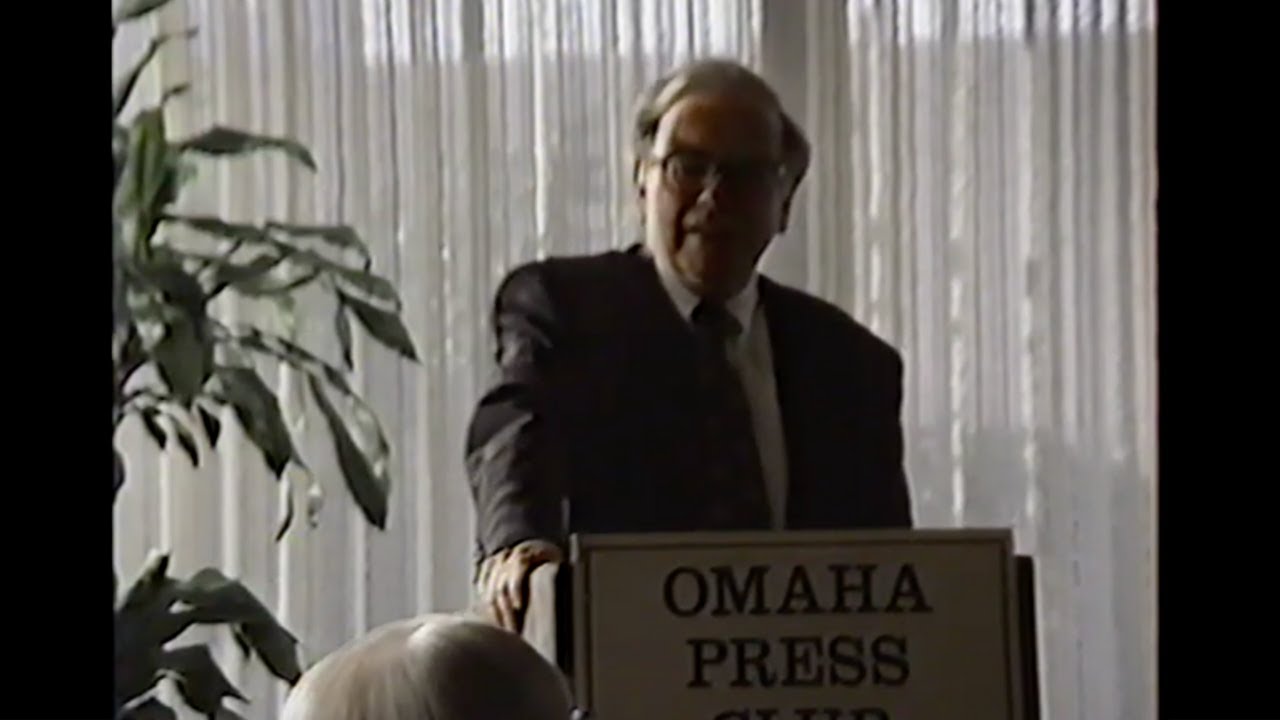
Chris Olsen opens the first of a series of education seminars run by the Omaha Press Club Education Committee. The evening is mostly questions and answers between the audience and Warren Buffett, and the subject is the news media. Olsen asks that questions focus on Buffett's dealings with the press, or his lack of them, and on situations that put him in the news. Robert Dorr of the Omaha World-Herald, who has covered Buffett for nearly three decades, introduces him. Dorr calls Buffett invariably accessible, courteous and straightforward but generally not talkative, and notes 862 mentions in the paper since 1983.
Buffett's opening remarks and family background
Buffett starts with his own history in newspapers. As a boy in Washington he delivered five routes, which gave him two-tenths of one percent of all Washington Post circulation. He carried both the Post and its competitor, the Times-Herald, so if his service was sloppy and people switched papers, he still turned up on their porch. He mentions an Alabama publisher who supposedly owed his prosperity to monopoly and nepotism.
His family ties to newspapers run on both sides. His father wanted to go into the newspaper business, but ended up a stock salesman, and Buffett was born in 1930. He says he has spent the rest of his life trying to keep the media out of his life, which is the subject of the evening, and he invites the toughest questions.
The national debt and Social Security
An audience member asks about a columnist's claim that the real national debt, including obligations, was around 14 trillion dollars. Buffett says it is a good figure, and that the country has a genuine fiscal imbalance. He thinks the columnist was probably counting the actual debt plus the present value of the promises made to people in the Social Security system. Virtually everyone has been promised a retirement income geared to inflation, and that piece alone comes to three and a half trillion or more. Social Security started with an insurance idea in mind, he says, but is now accepted as an intergenerational transfer payment.
The other side of the ledger is the power to tax. Buffett notes that all American corporations are worth about 4 trillion dollars, and that the government takes 34 percent of their profits while stockholders keep 66 percent, leaving out state income taxes. In effect the government already owns 34 percent of their earning power and could raise its share simply by passing a bill. So the country has enormous liabilities and also enormous untapped taxing power. That, he says, is why people do not get too upset about a 400 billion dollar deficit, and part of why government bonds keep selling as roughly the safest investment in the world.
Why the press struggles to cover slow-moving stories
A questioner points out that it is hard to write about a deficit when the difference between 377 and 378 billion dollars means little. Buffett agrees. The big stories are not dramatic events like Hurricane Andrew. They unfold over time and never produce a moment that grabs attention. Nobody runs a story saying he gained three ounces today because he ate more calories than he burned, but if he weighs 200 pounds more twenty years later, that becomes a story. Anything with a slow, glacial effect on society is very hard to cover while it is happening.
He adds that on important questions the policy cycle is longer than the electoral cycle and also longer than the news cycle. After the savings and loan debacle happened, it was easy to write about. At the Sun he could see a problem coming in Nebraska's industrial loan companies from their sketchy balance sheets, but the paper lacked the depth and specialization to write that story before it broke. The better news organizations occasionally publish long special pieces, he says, but this journalism is hard to sustain.
The economics of a one-newspaper town
Asked about a book that describes journalists as rude, arrogant and cynical, Buffett first makes an observation about the industry: with the caveat that he may be wrong, of the 1,600 papers the only one he can think of with a media critic covering the industry itself is a single paper. He then explains a stranger feature of newspapers. In his grandfather's day many papers competed in a single city, but today head-to-head competition can almost be counted on one hand. The economics push toward one newspaper per town. There is nothing evil in that, he says. There is no silver medal in the race, only one enormously valuable gold medal, and the second paper does not survive.
Buffett contrasts this with a hamburger stand or a shoe store, where a competitor would open next to the weakest one. Ten years earlier the Manchester Union Leader was called the worst paper in the country, yet no well-funded news organization would start a rival there. A paper can therefore make a lot of money whether it is terrific or lousy. He points to Roy Thomson's papers, which had some of the highest profit margins, and concludes there is no correlation between excellence and profitability. How good a paper is depends almost entirely on its owner.
An audience member asks whether the same logic applies to television. Buffett says television differs, but he notes a striking pattern. Across the top hundred markets, whoever leads the local news usually also leads the network newscast that follows, and he would bet the match is still around 95 out of 100. The biggest factor in winning local news is the show just before it, which is why a lead-in like Oprah matters. A popular local anchor is worth far more than comparable newspaper talent, he says, though he himself struggles to tell anchors apart on quality.
Newspapers and television are fundamentally different businesses, in his view. People basically want to read only one paper a day, and a second one priced at 15 cents instead of 25 will not lure them away. With a television set you can jump from station to station at no cost. Had television been like VHS against Betamax, with viewers committed to one incompatible format, one network could have driven the others out. Free roaming among channels makes the economics very different from print.
Endorsement policy at the Buffalo News
Asked whether the Buffalo News endorses candidates, Buffett says it does. The policy predates his involvement and has continued under his ownership, which began in 1977. The editor, Murray Light, writes a weekly column, and the editors generally decide the endorsements. The paper once endorsed five congressmen from a metro area of about a million and three hundred thousand people. Their voting records had nothing in common, so he concluded that the unstated policy was essentially to endorse the incumbent.
If a paper offers opinions on every other subject every day, he says, it makes little sense to decline on the biggest decision the public makes. He doubts that endorsements move many votes, and in a presidential race he guesses they mean virtually nothing. His rule of thumb is that the less public interest there is in a race, the more an endorsement matters. Even so, he thinks the paper should keep doing it.
What stories does the press miss, or get wrong
Asked which stories the media is missing or blowing out of proportion, Buffett says there is no great single answer. A slow-moving problem does not naturally generate drama. He then mentions that someone recently asked him about Berkshire Hathaway's stake in Wells Fargo and whether he had lost confidence in it. He will not comment on individual companies in this kind of setting. If he actually knew about an undiscovered fraud, he explains, he would not be talking about it from a podium. He would be acting on it in the market.
Reading habits, the New York Times anecdote, and time spent with reporters
Asked which two publications he would keep if limited to two, Buffett says his answer has changed over the years. Assuming he could still get the numbers he needs from a statistical service such as Value Line, he would probably pick the New York Times and Fortune. That reminds him of a story. The Times annual report once claimed same-day distribution to virtually every important metropolitan area, yet Omaha had none. He wrote to the publisher, noting that a friend in Des Moines, a smaller city, got the paper the same day. Another friend, Joe Rosenfield, wrote his own letter to Sulzberger, and in Buffett's telling the two letters brought same-day delivery to Omaha.
Another questioner asks about his policy on interviews, especially personal profiles. Buffett says he has probably spent more time with the media over the last ten years than any other chief executive he knows, even though each reporter tends to assume they are getting a rare exception. He has had five profiles in four years from national outlets. If he did not control the flow, it would take eighty hours a week. On specific stories he prefers reporters who already know the subject, because otherwise he can spend most of an hour teaching Insurance 101 without the reporter learning enough to write about it.
On profiles, he relays what editors told him. When those editors interviewed forty editors about the coverage they themselves had received, the biggest complaint was inaccuracy and the second was a conclusion the reporter had reached in advance. A reporter may already have the story in mind and be shopping for one usable sentence out of a forty-five minute interview. One editor, after being profiled, began imagining a family member as the subject of each story he wrote, to check both the spin and the accuracy of his facts.
Buffett thinks reporters follow a bell curve of talent and behavior, like the military, religious organizations or business. The overwhelming majority are trying to do their job well and are reasonably ethical, though under deadline pressure some might forget to mention a countervailing fact for a few minutes, and a few are happily unethical. A Nebraska Furniture Mart customer might likewise meet a rude salesperson. The difference, he says, is that a furniture customer chose to walk in and can leave, while in the news business you cannot opt out of the story. With the exception of an assassin, almost nothing else in society can do you as much damage as the press getting a story wrong.
Journalistic books and the power of the screen
An audience member asks about journalistic books such as Liar's Poker. Buffett says he reads everything, about seven hours a day, though his family thinks it is more. He compares such books to dramatized television: he recently read the screenplay for Barbarians at the Gate and knows many of its real characters. Ten, twenty or thirty million people will form their opinion of Henry Kravis and Ross Johnson from how a screenwriter chose to write them. Even a conscientious screenwriter shapes people into caricature to a degree.
On Liar's Poker, Buffett says he knows some things in it are dramatically inaccurate. He cites a scene in the opening involving John Meriwether, whom he knows well, which he thinks very unlikely to have happened as described. It makes a better story, though, and millions will believe it. There is enormous temptation to jazz a book up, he says, because a publisher who has paid a large advance expects a book that sells. He has always turned down large advances himself.
The screen is even more powerful than the book, he says. Whether or not Nixon actually knelt in prayer with Kissinger during Watergate, once a scene like that is on a screen, tens of millions will believe it. He finds the film JFK troubling for the same reason, since he thinks the odds that it is an accurate rendition of history are extraordinarily low. Yet twenty years on, more people may believe that version than any other. He also notes that the Constitution says nothing about the public's right to know. The press has a right to say things, but that does not give the public a constitutional right to know them.
Handling the Salomon Brothers crisis
An audience member asks about the criticism that Buffett used the media in handling the Salomon Brothers situation. He answers that they had to talk to people somehow, since reporters would write something every day regardless. On the first day, a Sunday in August, they called a press conference and a couple of hundred journalists came, some in shorts. He told them what he had learned in the previous 48 hours, making clear he could not be certain every fact was right. They also gave the government all their material, even where they could have asserted privilege, and made fifty or sixty written submissions to Congress that were updated as they learned more.
His view is that with a scandal on your hands, the best course is to lay out everything you know, never lie under any circumstances, and not let the lawyers run the process. Lawyers will advise saying nothing, which leaves the world judging a fast-moving story it does not understand, with real reputations at stake. The biggest risk is being surprised later by learning that something major you said was wrong. He says it is easier when you are not personally implicated. He cites Jim Burke at Tylenol, who ignored the lawyers and set out the facts publicly. Otherwise a vacuum forms and rumors fill it, as short-sellers spread rumors during Salomon.
Media as an investment: the three electronic highways
Asked whether media is a good investment, Buffett points to the section he wrote in the 1991 Berkshire Hathaway annual report. His view is that it is still a terrific business, but not quite as terrific as it used to be. Returns on capital are still very high compared with most businesses. Newspaper publishers have been fighting the telephone companies over electronic information services, he adds, because nobody used to being uncompetitive likes new entrants.
He tells of watching Monday Night Football on a big new picture and remarking on it to Murphy, who recalled the days of eight inches of black-and-white and only three networks. When Anheuser-Busch wanted to sell beer, they came to those three, and every year the networks raised prices. Buffett says that thirty years earlier there were three electronic highways into virtually every household, and the scarce factor was distribution, so the highway made the money. Now there are many highways, talent is scarce and captures the economics, and the business is good but not what it was.
Assigning yourself the right story
A questioner asks how an investor researches a company compared with how a journalist researches a story. Buffett says he tries to report on a company like a journalist looking at one he has never heard of, evaluating its management, competition, products, services, prices and costs. His job is to assign himself a story every morning, and it is essentially always the same: what is X actually worth? He recalls that in 1973, when Berkshire was buying into the Washington Post Company at a total valuation of about 80 million dollars, Bob Woodward was chasing Watergate. Had Ben Bradlee asked him for a week on what the company was worth, Buffett thinks Woodward would have come back with a good story, probably concluding it was worth something like 400 million.
He once suggested to Woodward that he assign himself such a story for an hour a day. He adds that this valuation story is much easier to report than working out what someone at the CIA was thinking. The Post then owned four big television stations, so a few station brokers could tell a reporter what comparable stations had recently sold for.
What interests Buffett is that journalists who have covered Berkshire over twenty-five years write their stories and virtually none ever buys the stock. This is usually not against any code of ethics, since reporters typically need only disclose trading to an editor. He can only say their analytical brain and their eyeballs are not connected to their own wallet. Ninety percent of investing, he says, is assigning yourself the right story, and the reporting is then fairly easy.
The media's influence on markets, and the presidential campaign
An audience member asks how far the media can sway market emotions, citing a case in which an article pushed a stock up and a comment from someone who was short pushed it back down. Buffett says media generally works on a very short time cycle, so a single story can say little of lasting importance about where a stock is heading. What he wants to know is what the next Coca-Cola is; he notes that a meaningful position bought at forty dollars a share in 1990 would be worth close to two million dollars. That insight unfolds too slowly for the news cycle. A story can move a stock for a day, he agrees, but that is noise around a price, not a signal about value.
Asked about campaign coverage, Buffett says some papers do a particularly good job. He names the New York Times and the Washington Post for covering what candidates actually do, and the material is there for anyone who seeks it. Network news cannot offer it in twenty-two minutes. Every four years, he adds, he feels horror at how coverage gravitates toward the horse race and personalities, and he calls the interest in Ross Perot's entry delicious copy but not necessarily good for understanding the issues.
Closing
The moderator says there is time for one more question, then reminds the audience that many of them will join Buffett for dinner at the club, and asks them not to crowd into one elevator, since there is plenty of time to get up there. He thanks Buffett once more and adjourns the seminar.